Study Tips 2026 are not only about sitting with books for long hours. Students today have access to textbooks, online classes, educational videos, mobile applications, digital notes, mock tests and AI-based learning tools. These resources have made education more accessible, but they have also created a new problem: students often have too much information and not enough focus.
Many students spend several hours studying but still struggle to remember what they learned. The real difference, therefore, is not always the number of hours spent studying. It is the way those hours are used. A student who studies with a clear plan, regularly tests their knowledge and revises important topics at the right time can often make better progress than someone who simply studies for long hours without a strategy.
For students in Bihar, effective study habits can be particularly useful during school examinations, Bihar Board examinations, college tests and competitive exam preparation. Students may have different schedules depending on school, coaching classes, travel and family responsibilities, but the basic principles of effective learning remain similar. The purpose of this guide is to explain practical study tips in 2026 that can help students become more organized, improve concentration, remember information for longer and approach examinations with greater confidence.
Why Smart Study Tips 2026 Are More Important Than Long Study Hours
Many students believe that studying for ten or twelve hours automatically means they are working harder and will achieve better results. However, time alone is not a reliable measure of learning. A student may spend six hours sitting with a book while frequently checking a phone, watching unrelated videos, rereading the same page or taking long breaks. Another student may study for four focused hours, actively recall what they learned, solve questions and revise difficult topics. The second student may achieve more useful learning even with fewer total hours.
The better question is not simply how many hours you studied. A more useful question is how much you understood, remembered and practiced during those hours. Effective studying is about concentration, active learning, revision and regular self-testing. Once students start measuring progress by learning outcomes rather than by the clock, their study routine often becomes more practical and sustainable.
How to Create a Study Timetable That Actually Works
A realistic study timetable is one of the simplest ways to improve academic performance. However, the timetable should be designed according to your real life instead of copying an unrealistic schedule from social media. If you attend school during the day and coaching classes in the evening, you cannot expect to study intensively for many additional hours every night. Your timetable should take your existing responsibilities into account.
Start by identifying the subjects that need the most attention. Difficult subjects or weak chapters should receive regular study time instead of being postponed until the end. Subjects that you already understand can receive shorter revision sessions. It is also important to leave some free time between study blocks for meals, travel, family responsibilities, rest and unexpected work. A flexible timetable is usually easier to maintain than a schedule that fills every minute of the day.
A useful timetable can also be divided into focused study sessions. For example, one session may be used for Mathematics, another for Science and another for language or social science. The exact duration does not have to be identical for every student. What matters most is that each session has a clear objective. Instead of writing “Study Science,” write a specific task such as “Complete Chapter 3 and solve 20 questions.” Clear goals make it easier to measure progress.
Use Focused Study Sessions to Improve Concentration
One effective way to improve concentration is to divide study time into manageable sessions. Some students prefer studying for around 25 minutes before taking a short break, while others can comfortably focus for around 50 minutes before resting for a few minutes. There is no single duration that works for everyone. The key idea is to create a period of uninterrupted concentration followed by a short recovery break.
During a focused session, avoid unnecessary phone checking, social media and unrelated conversations. Keep the materials required for the current task ready before beginning. If a random thought or unrelated task comes to mind, write it down and return to your studies instead of immediately switching away from the chapter. This simple technique can reduce the number of interruptions that slowly consume study time.
Breaks should also be used carefully. Standing up, drinking water, stretching or walking for a few minutes can help you return to the next session feeling refreshed. The purpose of a break is to recover, not to replace a short break with a long scrolling session.
Active Recall Can Make Revision More Effective
One of the most important study techniques is active recall. Instead of repeatedly reading the same information, students should regularly try to remember what they have learned without looking at the textbook. This can be done by closing the book and explaining the topic in your own words, writing down important points from memory or answering questions without checking the solution first.
For example, after studying a Science chapter, close your textbook and try to explain the main concept without looking at the notes. If you cannot remember a certain part, check the material again and then attempt to recall it a second time. This process helps identify the areas that have not been understood properly.
Active recall can be used across different subjects. A Mathematics student can attempt formulas and problem-solving steps from memory. A History student can reconstruct important events and dates. A Geography student can explain concepts without looking at the chapter. A language student can recall vocabulary, grammar rules or writing structures. The important point is that the brain is being asked to retrieve information instead of merely recognizing it on a page. This can be more heplfun in Private Bank Jobs Bihar
Revise at Different Intervals Instead of Waiting for the Exam
Last-minute revision is a common habit among students. A chapter may be studied once and then ignored for weeks before being opened again just before the examination. This can create unnecessary stress and make it more difficult to remember information.
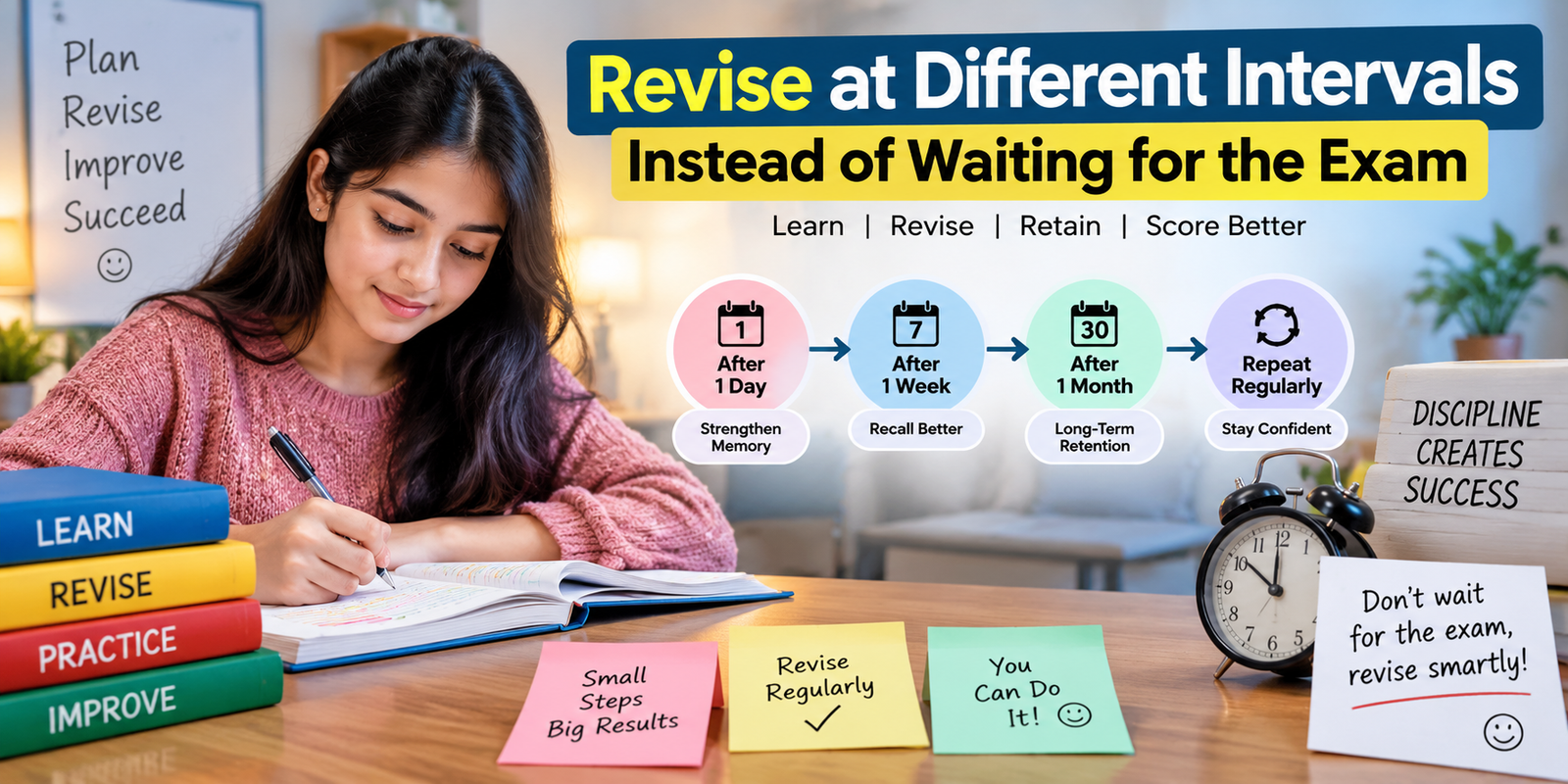
A better approach is spaced revision, where important topics are reviewed multiple times over a period of days or weeks. After learning a topic, you can review it briefly the next day, test yourself again after a few days and revisit it later. The exact revision schedule can vary from student to student, but the central principle is simple: do not rely on one large revision session immediately before the examination.
Spaced revision also makes final preparation easier because the material has already been reviewed several times. Instead of trying to relearn an entire syllabus in a few days, students can focus on strengthening areas that still feel difficult.
Practice Questions Instead of Only Reading Notes
Reading notes can create a feeling that you understand a topic even when you have not tested yourself properly. Practice questions provide a much clearer picture of your actual level of preparation. Once you complete a topic, start solving related questions without immediately looking at the answer.
This approach is especially important for Mathematics and Science, where understanding often needs to be demonstrated through problem-solving. It is also useful for language subjects, social science and competitive examinations. When you make a mistake, do not simply check the answer and move on. Understand why the mistake happened and record the point for later revision.
Previous examination papers can be particularly useful because they allow students to practice answering questions under realistic conditions. Try solving a complete paper within the expected time limit. Afterward, examine not only the questions you answered incorrectly but also the questions that consumed too much time.
Maintain an Error Notebook
An error notebook can become one of the most useful tools in an examination preparation routine. Whenever you make an important mistake, write down the question, the error and the correct concept. Over time, this notebook becomes a personalized revision resource based entirely on your own weaknesses.
For example, a Mathematics student may notice repeated calculation errors. A Science student may repeatedly forget specific concepts or units. A language student may make the same grammar mistakes. Instead of practicing everything equally, the error notebook allows the student to focus more attention on the areas where improvement is actually required.
Review this notebook regularly. The goal is not to create a huge collection of mistakes but to identify recurring problems and gradually eliminate them.
Make Short Notes for Faster Revision
Students often collect too many resources during exam preparation. They may have multiple guidebooks, downloaded PDFs, coaching materials, screenshots and handwritten notes. Having more material does not automatically mean better preparation. In many cases, it creates confusion.
Short notes can solve this problem. After studying a chapter, create a concise version containing major concepts, important formulas, definitions, dates, diagrams, examples and common mistakes. These notes should be much shorter than the original chapter. Their purpose is to make revision faster.
For students preparing for Bihar Board examinations, concise notes can become especially useful during the final stage of preparation when several subjects need to be revised within a limited amount of time. However, the notes should supplement the prescribed textbook and reliable study material rather than completely replace them.
Use Your Phone and AI Tools Carefully
Technology can either improve your study routine or destroy your concentration. The difference depends on how you use it. Smartphones provide access to educational videos, digital dictionaries, practice tests, online lectures and other learning resources. At the same time, notifications, social media and entertainment can consume large amounts of time.
During study sessions, consider turning off unnecessary notifications and keeping social media applications closed. Some students also find it useful to keep their phone away from the study desk when it is not required.
AI-based tools can also be useful in 2026 when used responsibly. Students can use them to ask for simpler explanations, create practice questions, generate revision quizzes or identify concepts that need further clarification. However, AI-generated information should not automatically be treated as correct. Students should verify important academic information using textbooks, teachers, official educational resources or other reliable sources. The best use of AI is as a learning assistant, not as a replacement for understanding and independent practice.
Sleep and Rest Are Part of Your Study Routine
Students sometimes sacrifice sleep because they believe those extra hours will provide more time for revision. However, regular sleep is important for concentration, memory, mood and everyday functioning. The Centers for Disease Control and Prevention notes that adequate sleep supports attention, concentration and well-being among students.
For adolescents, the CDC generally recommends around eight to ten hours of sleep per day, although individual needs can vary. Students should therefore avoid turning late-night study into a regular habit. Instead of repeatedly staying awake until very late, create a consistent routine that allows enough time for rest.
Rest does not mean wasting time. Proper breaks and sleep can help students return to studying with better concentration and energy.
Study Difficult Topics When You Have More Energy
Every student has periods of the day when concentration feels stronger. Some students are comfortable studying early in the morning, while others perform better later in the day. Identify your most productive period and use it for difficult work.
If you feel most focused in the morning, use that time for Mathematics, Physics, Chemistry or other challenging subjects. Easier tasks such as reviewing notes, reading or organizing material can be completed during periods when your energy is lower.
The purpose is not to follow a popular timetable. It is to build a routine around your personal concentration pattern while maintaining enough consistency to make progress.
Practice Writing Answers Before the Examination
Understanding a topic is not always enough for a written examination. Students also need to know how to communicate what they know clearly and within the available time.
Practice writing complete answers instead of only reading model solutions. For long questions, think about the structure of the answer. Start with the main idea, explain the relevant points clearly and include examples, diagrams or calculations where appropriate. Avoid unnecessarily complicated language when a simple explanation communicates the same idea more effectively.
Regular writing practice can also improve time management. During actual examinations, students need to divide the available time among multiple questions. Practicing complete papers can show whether you are spending too much time on one section.
Try Explaining Difficult Topics in Simple Language
A useful way to test your understanding is to explain a difficult topic as though you were teaching it to another student. Use simple words and avoid relying on the textbook’s exact sentences.
If you become stuck while explaining a concept, that may indicate that your understanding is incomplete. Return to the source material, clarify the confusing part and try the explanation again.
This method is particularly useful for Science, History, Geography, Economics and other subjects where students need to understand relationships between ideas rather than simply memorize isolated lines.
Create a Weekly Study Review
A weekly review can help you understand whether your study routine is actually working. At the end of each week, look at what you completed, what remains unfinished and which topics continue to create problems.
Ask yourself which subject improved, which chapter needs another revision and what caused distractions during the week. If your timetable was unrealistic, change it instead of feeling guilty about failing to follow it.
The goal of a weekly review is improvement. A timetable should evolve according to your progress. There is no reason to continue using a schedule that consistently does not fit your real circumstances.
Common Study Mistakes Students Should Avoid
One common mistake is creating a timetable that looks impressive but cannot realistically be followed. Another is spending too much time collecting study materials instead of actually practicing. Some students also highlight almost every sentence in a textbook, which reduces the usefulness of highlighting because nothing important stands out.
Another major mistake is studying only the easiest subjects. It feels good to complete familiar chapters, but weak areas may remain untouched. Students should deliberately schedule time for subjects and topics that require more effort.
Watching educational videos can also create a false feeling of progress. A lecture becomes much more useful when it is followed by active recall, note-making or practice questions. Education is not simply about consuming information; it is about being able to use and retrieve that information later.
A Practical Study Approach for Bihar Students
Students in Bihar can adapt these methods according to their own circumstances. A student living in a village may have different internet availability from a student in Patna or another major city. A student attending several hours of coaching may have less time for independent study than someone preparing from home.
The solution does not need to be complicated. Use textbooks and reliable offline resources when internet access is limited. Download essential educational material when connectivity is available. If you attend coaching, use self-study time to revise what was taught and solve questions instead of simply watching another lecture on the same topic.
Students who share a room with siblings can try to establish fixed quiet periods for study. Those who travel long distances may use part of the journey for light revision, vocabulary or audio learning when practical and safe.
A perfect study environment is not necessary. Consistency is often more valuable than perfection.
A Simple 30-Day Plan to Improve Your Study Routine
The first week can focus on building the habit. Create a realistic timetable, organize your books and notes, remove unnecessary distractions and begin regular focused study sessions.
During the second week, add active recall and practice questions. After completing each topic, test yourself instead of immediately moving to another chapter.
The third week can focus on weak areas. Review your mistakes, identify the chapters where your performance remains low and dedicate additional practice time to them.
During the fourth week, start taking timed tests or full-length practice papers. Analyze the results carefully and use the mistakes to improve your next revision cycle.
The purpose of this 30-day plan is not to create a perfect student overnight. It is to gradually replace ineffective habits with a system that is easier to maintain.
Final Thoughts
The best study tips in 2026 are not necessarily complicated. Successful preparation usually comes from a combination of planning, focused study, active recall, spaced revision, regular practice and consistent self-evaluation. Students do not need to study every waking hour. They need to make the hours they do study more meaningful.
For students in Bihar preparing for board examinations, school tests, college examinations or competitive exams, the most important step is to build a routine that matches their actual situation. Use technology where it genuinely helps, but do not allow it to become a distraction. Use AI for explanations and practice, but verify important information and continue developing your own understanding.
Most importantly, do not judge your entire preparation by one bad test or one unproductive day. Academic progress is rarely perfectly linear. What matters is whether your system helps you identify weaknesses, correct mistakes and improve over time.
Study with a purpose, revise regularly, practice what you learn and protect your concentration. When these habits become consistent, studying can become less stressful and much more productive.